HOME EDITORIAL International Cat Day: From Love for Jebu to a More Animal-Friendly Bangladesh
By Dr. Shahadat Hossain Parvez
Veterinarian and Organizing Secretary, Veterinary Doctors Association of Bangladesh (VAB)
August 8 was International Cat Day. The day was initiated in 2002 to raise global awareness about the welfare, needs, and protection of cats. Since 2020, International Cat Care has been responsible for coordinating the observance. But in Bangladesh, should this day remain limited to posting pictures of cats on social media, expressing affection, and exchanging greetings? I believe the time has come to use International Cat Day as an opportunity to initiate a broader national conversation on animal welfare, responsible pet ownership, and modern veterinary services in Bangladesh.
Bangladeshis’ love for cats is not new. Cats also occupy a special place in Islamic culture and tradition. The name of the Companion of the Prophet, Hazrat Abu Huraira (RA), is traditionally associated with his affection for cats. Islam discourages cruelty toward animals and emphasizes kindness and responsible treatment of living creatures as part of moral conduct. Compassion toward animals, therefore, is not a foreign concept for us; it is deeply rooted in our religious, social, and humanitarian values.
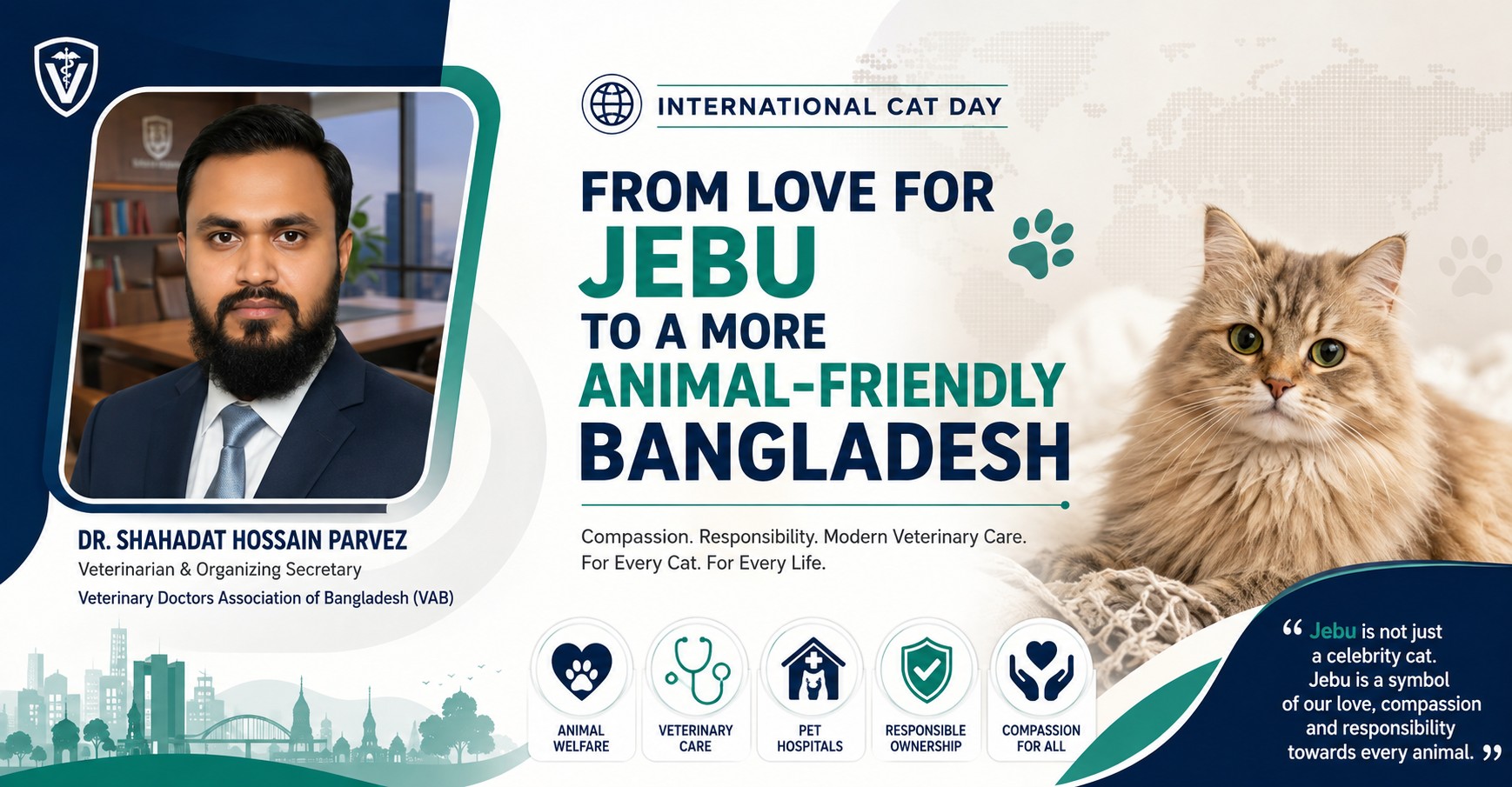
In recent times, Bangladesh’s affection for cats has gained a new dimension around ‘Jebu’, the pet cat of Prime Minister’s daughter Zaima Rahman. The Siberian cat became widely known on social media after returning to Bangladesh. Photographs and moments featuring Jebu with Prime Minister Tarique Rahman also generated considerable public interest. The Prime Minister himself has reportedly described Jebu as his daughter’s cat that has now become a cat loved by everyone. Jebu is therefore more than the name of a popular cat; it is also a symbolic example of the growing interest and emotional attachment of Bangladeshis toward companion animals.
This growing affection for animals also creates an opportunity to advance institutional animal welfare. The Bangladesh Animal Welfare Association, whose chief patron is Prime Minister Tarique Rahman, has been working on animal protection, treatment, shelter, and welfare across the country. Initiatives involving support for animal lovers, treatment of sick animals, animal ambulances, and pet hospitals have also come into discussion. This sends an important message: animal welfare can no longer be treated as an issue that deserves to be ignored at the policy and social levels.
At the same time, pet ownership is rapidly becoming part of Bangladesh’s urban social reality. Particularly in Dhaka and other major cities, interest is growing in breeds such as Persian, British Shorthair, Bengal, Ragdoll, Maine Coon, Siamese, Scottish Fold, and Siberian cats. At the same time, domestic cats are beloved companions in countless households. As cat ownership grows, a new market is developing around pet food, grooming, housing, equipment, breeding, and veterinary services. The pet sector is therefore no longer merely a matter of personal hobby; it is an emerging economic sector with opportunities for entrepreneurship, employment, and new areas of professional practice in veterinary medicine.
However, with this growth comes greater responsibility. Bringing a cat into one’s home means more than simply feeding it or taking attractive photographs. Cats require vaccination, deworming, proper nutrition, preventive healthcare, neutering, dental care, parasite control, behavioural care, and access to emergency treatment. Because of the close relationship between companion animals and humans, the One Health approach is particularly important. Animal health, human health, and environmental health cannot be considered in isolation. Pet health is therefore gradually becoming an issue with wider public-health implications.
In this context, Fisheries and Livestock State Minister Sultan Salahuddin Tuku reportedly announced yesterday at an event of the Bangladesh Society for Veterinary Education and Research that initiatives are being taken to establish at least one modern specialized pet hospital in every division of Bangladesh. Although several private pet treatment centres have developed in Dhaka, advanced diagnostic, surgical, and emergency veterinary services remain inaccessible to many pet owners across the country. As a result, some owners have reportedly travelled abroad, particularly to different cities in India, for treatment of complicated conditions.
If we can develop modern specialized veterinary infrastructure within Bangladesh, it will not only reduce the financial burden on pet owners but also create new opportunities for specialization, research, internships, and employment in veterinary medicine.
A comprehensive specialized pet hospital should offer much more than basic treatment. Services should include emergency and critical care, internal medicine, surgery, diagnostic laboratory facilities, radiology, ultrasonography, dentistry, dermatology, nutrition counselling, anaesthesia, intensive care, vaccination, and inpatient treatment. At the same time, structured internship programmes, advanced training, and professional development opportunities should be created for veterinary graduates and young veterinarians. A network of such hospitals at the divisional level, developed through public-private partnerships, could establish a modern pet healthcare system across Bangladesh.
One of the most sensitive areas of the growing pet sector is breeding and commercial sales. As demand for cats increases, so does breeding and trade in the name of specific breeds. Minimum animal-welfare standards must therefore be ensured. Those involved in cat breeding and sales must act responsibly. Using animals with serious hereditary disease risks for indiscriminate breeding, excessively breeding female cats, selling kittens at an inappropriate age, concealing vaccination or health information, or misleading buyers about breed or pedigree should not be acceptable.
In particular, breeding solely for physical appearance can create long-term health problems in certain breeds. The folded-ear characteristic of Scottish Fold cats, for example, has long been associated with concerns about cartilage and skeletal disorders. Our pet sector must therefore move away from a competition to produce “beautiful animals” and embrace the principle that healthy animals must come first.
Every cat sold should ideally be accompanied by vaccination records, deworming history, health information, and, where appropriate, a veterinary health certificate. A recognized registration or certification system for responsible breeders should also be considered.
Organizations such as the Small Animal Veterinary Association of Bangladesh (BASAVA), along with other animal-welfare organizations and veterinary initiatives, are working to improve pet healthcare and public awareness. Government agencies, the Veterinary Doctors Association of Bangladesh (VAB), veterinary universities, veterinarians, pet owners, breeders, and entrepreneurs in the pet sector should work together in a coordinated manner.
Animal welfare is not the responsibility of any single organization. It is a shared social and institutional responsibility. Our objective should be to bring rescue, treatment, vaccination, neutering, adoption, and responsible pet ownership under a coordinated framework.
I believe that from next year, the Veterinary Doctors Association of Bangladesh could take the initiative of launching a national cat-care programme around International Cat Day. Veterinary health camps, rabies vaccination awareness, responsible pet-ownership campaigns, adoption programmes, awareness about the importance of sterilization of community cats, educational programmes in schools, colleges and universities, and guidelines on responsible breeding could all be incorporated into such an initiative.
At the same time, proposals could be submitted to the government for establishing specialized pet hospitals in every division, developing a national pet-health policy, and introducing appropriate guidelines for responsible breeding and commercial sale of companion animals.
Finally, Jebu is no longer simply a celebrity cat in the eyes of many Bangladeshis; Jebu has become a beautiful symbol of affection toward animals. If the love and interest surrounding Jebu can be transformed into more responsible and humane treatment of the countless pet and community cats across Bangladesh, that affection can become a powerful force for a broader animal-welfare movement.
Across Bangladesh’s cities, villages, campuses, and neighbourhoods, countless cats live alongside people. Some are cherished members of families, while others survive as community animals. All of them need compassion, a safe environment, appropriate healthcare, and humane treatment.
If our love for Jebu inspires compassion and responsibility toward every cat, that will be the most meaningful expression of that love.
International Cat Day should therefore be more than a celebration—it should be a policy reminder. Through our love for Jebu, let us expand the scope of our compassion for animals. Pet owners should become responsible, breeders should act ethically, veterinarians should receive modern infrastructure, and community animals should have access to treatment and protection. May the love for Jebu spread into compassion for every animal.
A healthy cat, a responsible owner, a humane society, and a modern veterinary healthcare system—let these four goals guide us toward a more animal-friendly Bangladesh. Let International Cat Day be not merely a day to celebrate cats, but a commitment to our responsibility toward every living creature.