



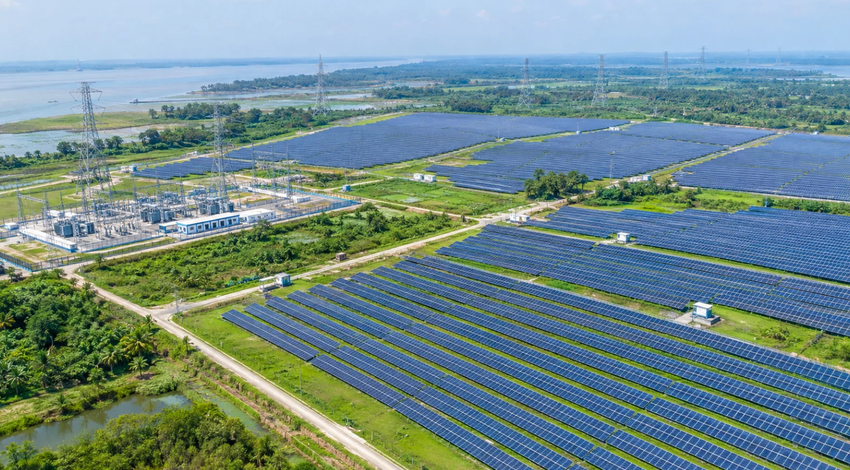
The Bangladesh Power Development Board (BPDB) is expected to get ECNEC approval this week for a 442-megawatt (MW) grid-connected solar power project at Rampal in Bagerhat.
“The Planning Commission has approved the project, while a Project Evaluation Committee (PEC) meeting has also been held regarding the proposal,” BPDB Chairman Engineer Rezaul Karim told BSS today.
He said the project would be built beside the existing 1,320-MW coal-fired power plant at Rampal and implemented in phases from 2028.
The proposed solar photovoltaic (PV) plant will be developed on 918.5 acres of unused land previously acquired for a coal-fired power project, BPDB Member Md Zahurul Islam said.
“We will use the Power Development Fund to construct the solar power project on vacant land of the Rampal power plant,” he said.
The project has an estimated cost of Tk 2,502.4 crore, according to the BPDB.
Major site development works, including land filling and boundary protection, have already been completed, which is expected to reduce construction costs and shorten the implementation period compared with a greenfield project.
A feasibility study by the Infrastructure Investment Facilitation Company (IIFC) found that the existing site infrastructure would significantly lower construction expenses, a BPDB official said.
The plant will be connected to the national grid through a new 230-kilovolt transmission system linked to the nearby Bangladesh-India Friendship Power Company Limited (BIFPCL) substation.
The proposed project is expected to add clean electricity to the national grid, reduce carbon emissions and lessen Bangladesh’s dependence on imported fossil fuels.
It is also expected to help reduce environmental pressure on the ecologically sensitive Sundarbans, the world’s largest mangrove forest.
The project is in line with Bangladesh’s target of meeting 20 percent of its annual electricity demand from renewable sources by 2030. It also supports the country’s commitments under the Paris Agreement, the Sustainable Development Goals (SDGs) and the Integrated Energy and Power Master Plan (IEPMP) 2023.
Shafiqul Alam, Lead Energy Analyst at the Institute for Energy Economics and Financial Analysis (IEEFA), said converting land originally earmarked for a coal-fired plant into a solar project reflects Bangladesh’s changing energy priorities.
“The project will contribute to Bangladesh’s long-term energy security by reducing its dependence on imported fossil fuels. It is a positive step towards building a cleaner, more sustainable and more resilient power sector,” he said.
The project is also expected to offer a competitive tariff of Tk 6.18 per unit, around 43 percent lower than the estimated Tk 8.87 per unit tariff of the proposed 220-MW solar plant at Sonagazi in Feni, according to the BPDB.
The government has meanwhile launched a nationwide programme to expand rooftop solar power and develop a network of entrepreneurs and service providers under the National Renewable Energy Development Strategy 2026-2030.